

You’ve probably heard it before: “It takes 21 days to form a habit.”
Maybe you tried it. You committed to morning runs, journaling, or drinking more water. You white-knuckled your way through three weeks, expecting the behavior to feel automatic by day 22.
But it didn’t.
Instead, you felt the same resistance, the same need for willpower, and eventually you stopped.
Here’s the uncomfortable truth: the 21-day rule is a myth. And believing it might be sabotaging your ability to form a habit in the first place.
The real timeline? It’s messier, more personal, and depends on factors most people never consider. Understanding how habits actually form and how long it genuinely takes can transform your approach to building better behaviors.
Let’s dig into what science tells us, why most advice gets it wrong, and what you can do differently.
What Does It Mean to Form a Habit?
Before we talk timelines, let’s clarify what we mean when we say “form a habit.”
A habit isn’t just something you do regularly. It’s a behavior that becomes automatic triggered by a specific cue and performed with minimal conscious thought.
Think about brushing your teeth. You don’t debate whether to do it. You don’t need a pep talk. You finish dinner, feel that filmy sensation on your teeth, walk to the bathroom, and your hand reaches for the toothbrush. The decision happens on autopilot.
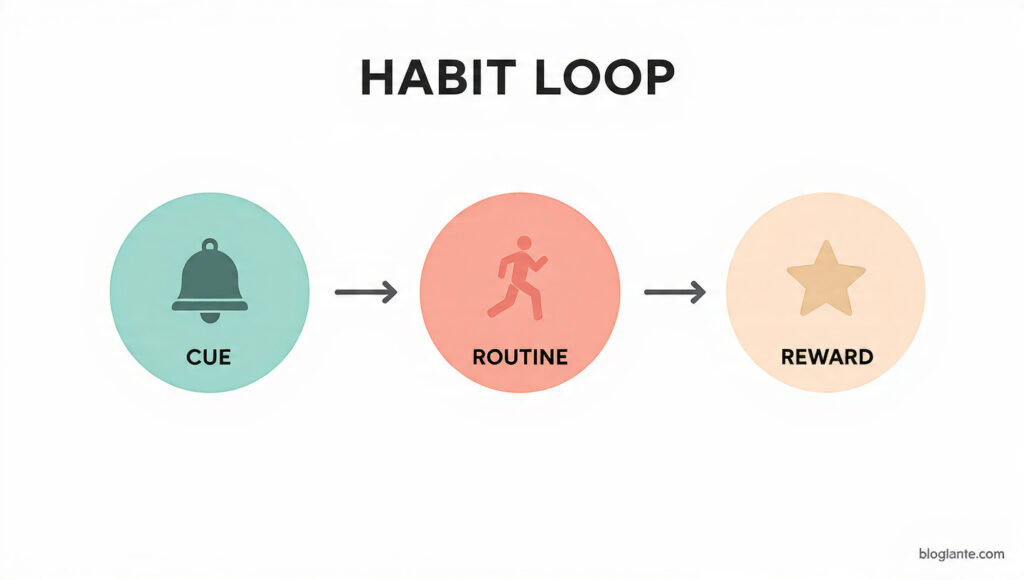
Psychologists describe this process as the habit loop, which consists of three parts:
- Cue: The trigger that initiates the behavior (feeling hungry, walking past the gym, opening your phone)
- Routine: The behavior itself (eating a snack, working out, scrolling social media)
- Reward: The benefit you gain, which reinforces the loop (satisfaction, endorphins, entertainment)
When this loop repeats enough times in consistent contexts, your brain creates neural pathways that make the behavior automatic. You’ve officially formed a habit when you perform the action without deliberate decision-making.
That’s the goal we’re chasing not just repetition, but automaticity.

How Long Does It Really Take to Form a Habit?
The 21-day myth traces back to Dr. Maxwell Maltz, a plastic surgeon in the 1960s who noticed his patients took about 21 days to adjust to their new appearance. He wrote about this observation in his book, and the idea spread like wildfire morphing from “at least 21 days” to “exactly 21 days” as it passed through self-help circles.
But actual research tells a different story.
A study by health psychology researcher Philippa Lally and her team at University College London followed 96 people as they tried to form new habits. The participants chose simple behaviors like drinking water at lunch or doing a 15-minute walk after breakfast.
The results? On average, it took 66 days for a behavior to become automatic.
But here’s where it gets interesting: the range was huge. Some participants formed their habit in just 18 days. Others needed 254 days more than eight months.
This variation isn’t random. The time it takes to form a habit depends on several critical factors, which we’ll explore next.
The takeaway? Stop expecting magic at the three-week mark. Real habit formation requires patience and realistic expectations.
Factors That Affect How Long It Takes to Form a Habit
Not all habits are created equal. A simple behavior in a supportive environment will stick faster than a complex one filled with friction.
Complexity of the Habit
Drinking a glass of water when you wake up is straightforward. It requires one action, takes 30 seconds, and doesn’t demand much energy.
Compare that to learning a new language for 30 minutes every morning. This involves finding materials, maintaining focus, pushing through frustration, and resisting the urge to quit when progress feels slow.
Simple habits form faster because they require less cognitive load and willpower. Complex habits need more repetition before they feel natural.
Consistency Beats Intensity
Here’s a counterintuitive truth: doing something small every day beats doing something intense occasionally.
A person who does five pushups every morning will form a habit faster than someone who does 100 pushups three times a week. Why? Because habit formation relies on the frequency of the cue-routine-reward loop, not the magnitude of effort.
Missing days breaks the pattern. Your brain doesn’t recognize inconsistent behavior as a habit worth automating.
Environment and Triggers
Your environment shapes your behavior more than you realize.
If you want to read before bed but your phone sits on your nightstand while your book hides in another room, you’ve designed your environment to fail. The easiest action wins and scrolling requires less effort than getting up to grab a book.
Strong habits are tied to obvious, consistent cues. When the context stays the same, your brain connects the dots faster: “When I sit at my desk with coffee, I journal.” The routine becomes part of the setting.
Motivation and Identity
Motivation gets you started, but identity keeps you going.
When you’re motivated, you think: “I want to exercise.” When it becomes part of your identity, you think: “I’m someone who exercises.”
This shift matters because identity-based habits are more resilient. You’re not forcing yourself to act differently you’re acting in alignment with who you are.
If you see yourself as a healthy person, skipping workouts feels wrong. The behavior reinforces the identity, which reinforces the behavior.
Emotional and Mental State
Stress, anxiety, and life disruptions slow habit formation.
When you’re emotionally drained, your brain defaults to familiar patterns usually the easy, comfortable ones. This is why people abandon new habits during challenging times and revert to old behaviors like stress-eating or doomscrolling.
Building habits during stable periods gives you the mental bandwidth to push through the early awkward phase before automaticity kicks in.
Examples of Simple vs Complex Habits
Understanding the difference between simple and complex habits helps set realistic timelines.
Simple habits (faster to form):
- Drinking water first thing in the morning
- Taking vitamins with breakfast
- Putting your phone in another room before bed
- Laying out workout clothes the night before
These require minimal decision-making and low effort. They’re easy to repeat consistently, which speeds up the process to form a habit.
Complex habits (slower to form):
- Running five miles every morning
- Writing 1,000 words daily
- Meal prepping every Sunday
- Meditating for 30 minutes
These demand more time, energy, and skill development. They also involve multiple steps, which means more opportunities for friction and failure.
If you’re trying to build a complex habit, break it down. Want to run daily? Start by putting on running shoes. Want to write more? Begin with one sentence. Simplify until the barrier to entry disappears.
Why Most People Fail to Form a Habit
Knowing how long habits take doesn’t guarantee success. Most people fail not because they lack discipline, but because they approach habit formation with flawed strategies.
Unrealistic Expectations
When you believe the 21-day myth, day 22 feels like failure. You expected the behavior to feel effortless, but it still requires effort. So you assume something’s wrong with you and you quit.
The truth is, even after a habit forms, there will be days when you don’t feel like doing it. Automaticity reduces decision fatigue, but it doesn’t eliminate the need for occasional willpower.
All-or-Nothing Mindset
You planned to exercise every day. You missed Wednesday because of a work deadline. Now the streak is broken, so why bother on Thursday?
This perfectionist thinking kills habits. Research shows that missing a single day doesn’t significantly impact long-term habit formation but using one slip as permission to quit definitely does.
Progress isn’t linear. What matters is getting back on track quickly, not maintaining a flawless record.
Lack of Systems
Relying on motivation is a losing strategy. Motivation is an emotion, and emotions fluctuate.
Systems, on the other hand, are reliable. A system is a set of processes that make the behavior easier to repeat regardless of how you feel.
Want to read more? Create a system: put a book on your pillow each morning, so you see it when you go to bed. Want to eat healthier? Prep vegetables on Sunday, so cooking is easier all week.
When the system is solid, the habit follows.
Poor Habit Tracking
What gets measured gets managed.
Tracking your habit creates accountability and provides visual proof of progress. Whether you use an app, a calendar, or a simple checklist, seeing your consistency builds momentum.
But many people either don’t track at all, or they track inconsistently, which defeats the purpose.
Proven Tips to Form a Habit Faster
You can’t force a habit to form overnight, but you can optimize the process.
Start Ridiculously Small
James Clear, author of Atomic Habits, suggests the two-minute rule: scale your habit down to something that takes two minutes or less.
Want to form a habit of daily yoga? Start with one pose. Want to read more? Read one page.
This approach removes resistance. Once you start, continuing feels natural. But even if you stop after two minutes, you’ve reinforced the identity and kept the streak alive.
Stack Habits
Habit stacking links a new behavior to an existing one, using your current routine as the trigger.
The formula: “After [current habit], I will [new habit].”
- After I pour my coffee, I will write in my gratitude journal.
- After I brush my teeth, I will do 10 pushups.
- After I close my laptop, I will do a five-minute stretch.
By piggybacking on established patterns, you leverage existing cues and make the new behavior easier to remember.
Track Your Progress
Use whatever method works for you apps like Habitica or Streaks, a paper calendar with X’s, or a simple note on your phone.
The act of tracking makes the habit real. It also reveals patterns. Maybe you always skip your habit on Tuesdays now you can investigate why and adjust.
Focus on Identity, Not Outcomes
Instead of “I want to lose weight,” think “I’m becoming someone who prioritizes health.”
Instead of “I want to write a book,” think “I’m a writer who shows up every day.”
This identity-first approach changes your relationship with the behavior. You’re not forcing yourself to act out of character you’re honoring who you’re becoming.
Build Systems, Not Schedules
Don’t just decide to work out at 6 a.m. Design your environment so that working out at 6 a.m. is the easiest option.
Sleep in your workout clothes. Put your shoes by the door. Pre-load your workout playlist. Remove every source of friction between waking up and starting the behavior.
When the system is bulletproof, willpower becomes optional.

Conclusion
So, how long does it take to form a habit?
The honest answer: it depends.
For simple behaviors in supportive environments, you might feel automaticity in a few weeks. For complex habits with lots of friction, expect several months. Research suggests an average of 66 days, but your mileage will vary.
What matters more than the timeline is your approach. Stop chasing perfection. Stop believing that missing a day means failure. Stop waiting for motivation to strike.
Instead, focus on systems, simplify your habits, and commit to showing up even when it’s not easy.
The goal isn’t to form a habit in 21 days. The goal is to become the kind of person who doesn’t quit when day 22 arrives.
Start small today. Track one behavior. Make one change.
Because the real question isn’t how long it takes to form a habit it’s whether you’re willing to keep going long enough to find out.
Explore More Articles to Empower Your Life
If you found value in learning how to Rewire Your Brain, you’ll love these related articles designed to help you grow and take control of your life:
- 9 Proven Ways to Stop Self Sabotaging and Achieve Success
- 7 Proven Ways to Build Self Control and Transform Your Willpower
- 12 Bad Habits That Are Quietly Ruining Your Life
- 7 Ways to Build Good Habits to Overcome Fear of Failure
If you’re interested in exploring deeper perspectives on the human mind, intelligence, spirituality, and moral growth, you may also find value in thoughtful articles published on Kham Khayal. The platform explores topics like human intelligence, the psychology behind forgiveness, spiritual awareness, and timeless moral values through a reflective and culturally rich lens. Reading diverse viewpoints helps broaden understanding and supports personal growth on multiple levels.