
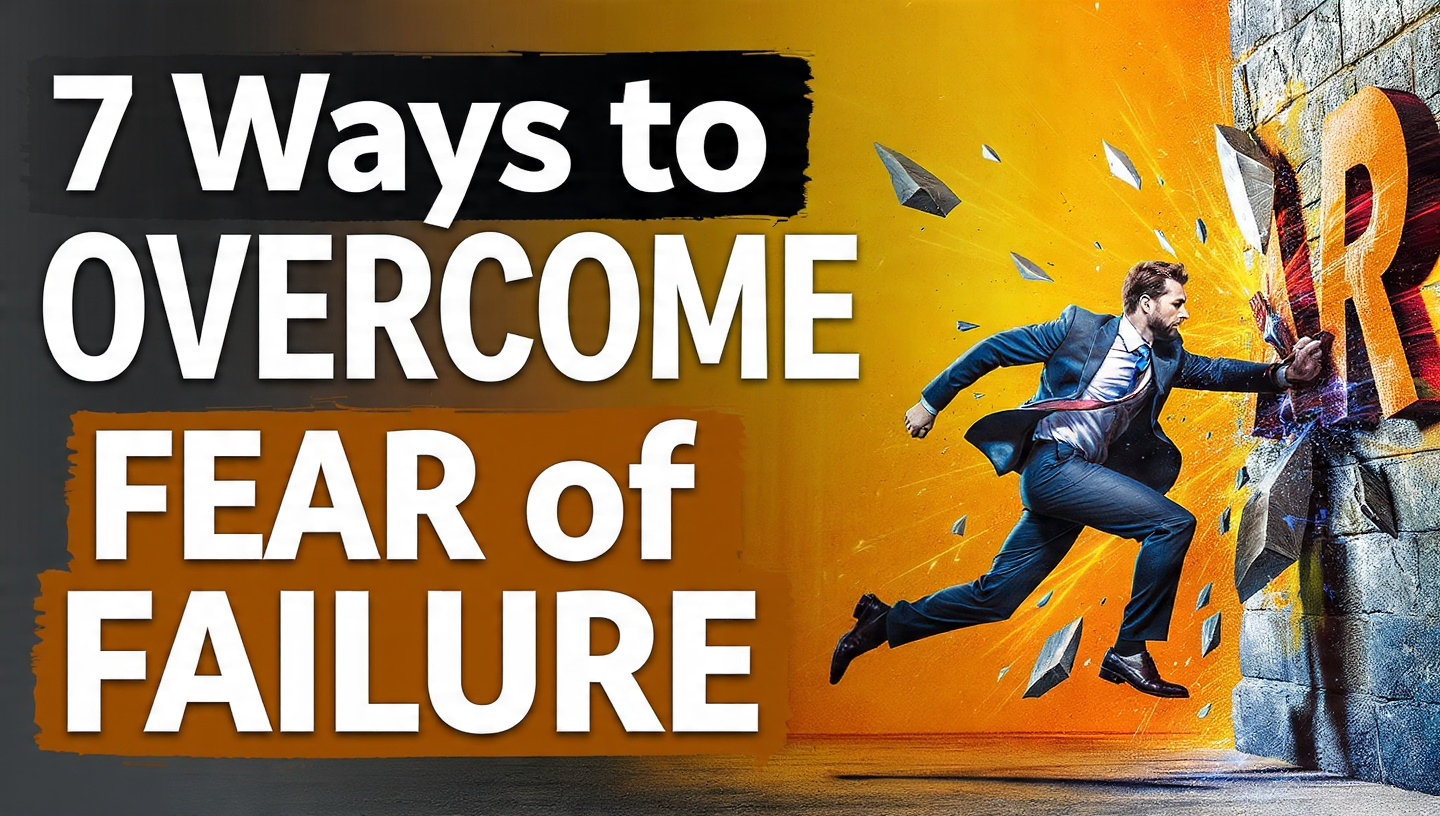
Have you ever held back from pursuing something you truly wanted because a little voice whispered, “What if you fail?” Maybe you didn’t apply for that dream job, start that business, or share your creative work with the world. You’re not alone. Fear of failure affects millions of people, quietly sabotaging dreams and keeping potential locked away.
Here’s the truth: failure isn’t your enemy it’s your teacher. But that nagging fear? It can feel paralyzing. The good news is that you can dismantle this fear brick by brick. One of the most powerful tools in your arsenal is learning to build good habits that rewire how you think, act, and respond to challenges. When you build good habits consistently, you create a foundation of confidence that makes failure feel less threatening and success more achievable.
In this article, we’ll explore what fear of failure really is, why it develops, how to recognize its symptoms, and most importantly, seven practical strategies to overcome it with the ability to build good habits at the core of your transformation.
What Is Fear of Failure?
Fear of failure, or “atychiphobia” in psychological terms, is an intense anxiety about making mistakes or not meeting expectations. It’s more than just nervousness before a big presentation. It’s a deep-rooted fear that can prevent you from taking action altogether.
This fear manifests differently for everyone. For some, it’s avoiding new opportunities. For others, it’s perfectionism working endlessly on something but never feeling it’s “good enough” to share. Either way, the result is the same: you stay stuck.

Causes of Fear of Failure: Where Does It Come From?
Understanding the roots of your fear is the first step toward overcoming it. Let’s examine the common causes:
1. Childhood Experiences and Upbringing
Your early years shape how you perceive failure. If you grew up in an environment where mistakes were criticized harshly or where love felt conditional on achievement, you might have internalized the belief that failure equals unworthiness.
Example: A child who brings home a B+ and hears, “Why wasn’t it an A?” learns that anything less than perfect is disappointing.
2. Perfectionism
Perfectionists set impossibly high standards. When the bar is always just out of reach, every attempt feels like a potential failure. This creates a cycle where you’re either overworking yourself to exhaustion or avoiding tasks entirely.
3. Social Comparison and Social Media
We live in an age where everyone’s highlight reel is on display. Scrolling through social media, you see success after success—friends getting promotions, influencers launching businesses, peers traveling the world. What you don’t see are the failures, rejections, and struggles behind those moments. This skewed perception makes your own failures feel magnified.
4. Past Traumatic Failures
A particularly painful failure a public embarrassment, a devastating rejection, a business that collapsed can leave emotional scars. Your brain, trying to protect you, becomes hypervigilant about avoiding similar situations.
5. Low Self-Esteem
If you don’t believe in your abilities or worth, failure feels like confirmation of what you already suspected: “I’m not good enough.” This creates a self-fulfilling prophecy where fear prevents you from trying, which prevents you from succeeding.
6. Cultural and Societal Pressure
Some cultures place enormous emphasis on achievement and success. The pressure to meet family expectations, maintain status, or achieve certain milestones by specific ages can intensify the fear of falling short.
Symptoms of Fear of Failure: How to Recognize It
Fear of failure doesn’t always announce itself loudly. Sometimes it whispers. Here are the signs:
Mental and Emotional Symptoms:
- Persistent anxiety when thinking about new projects or challenges
- Negative self-talk (“I’ll probably mess this up anyway”)
- Catastrophizing imagining the worst possible outcomes
- Imposter syndrome feeling like a fraud despite your accomplishments
- Excessive worry about what others think
- Feeling overwhelmed by even small tasks
Behavioral Symptoms:
- Procrastination—constantly delaying action
- Over-preparation—researching endlessly without taking action
- Avoidance—turning down opportunities that involve risk
- Self-sabotage—unconsciously creating obstacles to avoid trying
- Quitting prematurely—giving up at the first sign of difficulty
- Seeking excessive reassurance from others before making decisions
Physical Symptoms:
- Racing heart or tension when facing challenges
- Sleep disturbances due to worry
- Fatigue from constant stress
- Difficulty concentrating
If these symptoms resonate with you, remember: awareness is power. Recognizing these patterns is your first step toward change.
How to Overcome Fear of Failure: 7 Strategies That Work
Now for the part you’ve been waiting for the practical solutions. These strategies aren’t just theory; they’re actionable steps you can start implementing today.
1. Reframe Your Relationship with Failure
Why it matters: Your perception of failure shapes your emotional response to it.
How to do it: Start viewing failure as feedback, not as a final verdict on your worth. Every successful person has failed repeatedly. Thomas Edison famously said he didn’t fail 10,000 times he found 10,000 ways that didn’t work.
Action step: When you experience a setback, ask yourself three questions:
- What can I learn from this?
- What would I do differently next time?
- What did I do well, even if the outcome wasn’t perfect?
This simple habit shifts your brain from judgment mode to growth mode. When you build good habits around self-reflection, you transform failure from a source of shame into a tool for improvement.
2. Build Good Habits Around Small, Consistent Action
Why it matters: Fear thrives when tasks feel overwhelming. When you build good habits of taking small, consistent steps, you create momentum that makes bigger challenges feel manageable. The ability to build good habits is your secret weapon against fear because habits operate below the level of conscious decision-making—meaning fear has less opportunity to interfere.
How to do it: Break your goals into tiny actions you can do daily. Want to write a book but fear it won’t be good enough? Commit to writing just 200 words daily. Want to start a business but worry about failing? Spend 15 minutes each day researching or planning.
The habit-building framework to build good habits effectively:
- Start ridiculously small (so small you can’t fail)
- Stack it onto an existing habit (After I pour my morning coffee, I will…)
- Track your progress (Use a calendar, app, or journal to mark off each day)
- Celebrate small wins (Acknowledge every completed action)
When you build good habits this way, you’re not just working toward a goal you’re becoming someone who takes consistent action despite fear. That identity shift is transformative. Learning to build good habits means you’re creating a system where success is the default outcome.

3. Practice Self-Compassion as a Daily Habit
Why it matters: Harsh self-criticism amplifies fear. Kindness creates safety, which allows you to take risks.
How to do it: Treat yourself like you would treat a good friend who’s struggling. When you make a mistake, instead of thinking “I’m so stupid,” try “I’m human, and I’m learning.”
Action step: Create a self-compassion statement you can repeat when fear strikes: “I’m doing my best, and that’s enough. Every expert was once a beginner. I give myself permission to be imperfect.”
Research by Dr. Kristin Neff shows that self-compassion actually increases motivation and resilience far more than self-criticism ever could. When you build good habits of self-kindness, you create emotional resilience that helps you bounce back from setbacks faster.
4. Set Process Goals and Build Good Habits Around Them
Why it matters: You can’t always control outcomes, but you can control your actions. When your goals focus on what you do rather than what you achieve, failure becomes less threatening.
How to do it:
- Outcome goal: “Lose 20 pounds”
- Process goal: “Exercise 4 times per week and eat vegetables with every meal”
The process goal gives you something concrete to accomplish daily. When you build good habits around your process, success becomes inevitable over time, regardless of occasional setbacks. The key is to build good habits that align with your values and move you toward your desired outcome without being attached to a specific timeline.
Action step: For each major goal, identify 2-3 daily or weekly actions you can control. Focus your energy there and build good habits that support these actions.
5. Embrace the “Prototype Mindset” Habit
Why it matters: Perfectionists wait for perfect conditions and perfect execution. The prototype mindset embraces iteration and improvement.
How to do it: Think of yourself as a designer creating prototypes. Your first attempt is Version 1.0 not the final product. You’ll release it, get feedback, and create Version 2.0. Then 3.0. Each iteration gets better.
This approach removes the pressure of getting it right immediately. It also makes “failure” impossible you’re just gathering data for your next iteration. To truly benefit from this mindset, you need to build good habits around iteration and continuous improvement.
Example: Don’t wait to launch the perfect website. Launch a simple one-page site, learn what works, then improve it. Reid Hoffman, founder of LinkedIn, famously said, “If you’re not embarrassed by the first version of your product, you’ve launched too late.”
When you build good habits of shipping imperfect work, getting feedback, and iterating, you develop what I call “failure immunity” the ability to keep moving forward regardless of setbacks.
6. Visualize Success But Also Prepare for Obstacles
Why it matters: Positive visualization alone isn’t enough. Combining it with obstacle planning creates realistic confidence.
How to do it: Use the WOOP method (Wish, Outcome, Obstacle, Plan):
- Wish: Identify what you want to achieve
- Outcome: Visualize the best possible result
- Obstacle: Identify what might go wrong or what fear might show up
- Plan: Create a specific if-then plan for handling obstacles
Example: “If I start feeling overwhelmed by fear when it’s time to submit my application, then I will take three deep breaths, remind myself of my preparation, and submit it without overthinking.”
This mental rehearsal prepares you for challenges without catastrophizing. Make it a regular practice build good habits of visualization and planning at the start of each week or before major challenges.
7. Surround Yourself with Growth-Minded People
Why it matters: Your environment shapes your beliefs. If you’re surrounded by people who fear failure, you’ll absorb that energy. If you’re surrounded by people who take bold action and learn from setbacks, their courage becomes contagious.
How to do it:
- Join communities (online or offline) focused on growth and development
- Find a mentor or coach who’s overcome similar fears
- Share your goals with supportive friends who will encourage you
- Limit time with people who feed your fears or criticize your ambitions
- Build good habits of connecting with inspiring people regularly
Action step: Identify one person in your life who embodies courage and growth. Spend more time with them or ask them about how they handle fear. Schedule regular check-ins when you build good habits of surrounding yourself with the right people, their mindset naturally influences yours.
The Power of Habits: Your Shield Against Fear
You’ve probably noticed that the phrase “build good habits” appears throughout these strategies. That’s intentional. Here’s why the ability to build good habits is so powerful against fear:
1. Habits create automaticity: When something becomes a habit, you do it without requiring massive willpower or motivation. You brush your teeth even when you don’t feel like it. Similarly, when taking action becomes habitual, fear has less opportunity to interfere.
2. Habits build evidence: Each time you complete a small habit, you create proof that you’re capable. This evidence accumulates, strengthening your self-belief. When you build good habits consistently, you’re essentially building a portfolio of success.
3. Habits reduce decision fatigue: Fear often paralyzes us during decision-making. Habits eliminate the need to decide—you just follow your established routine. This is why successful people build good habits around their most important activities.
4. Habits compound: Small actions repeated consistently create remarkable results over time. When you build good habits, you’re investing in your future self. A 1% improvement daily compounds to being 37 times better in a year.
5. Habits reshape identity: James Clear, author of Atomic Habits, says every action is a vote for the person you want to become. When you build good habits of taking action despite fear, you’re not just accomplishing tasks—you’re becoming a courageous person.
Think of it this way: you can’t habit-ize courage directly, but you can create habits that make courageous action easier. A daily journaling habit helps you process fears. A morning routine creates stability. A learning habit builds competence. Together, when you build good habits across multiple areas of your life, you construct a foundation where fear has less power.
A Practical Plan to Build Good Habits That Defeat Fear
Let’s make this concrete. Here’s a 30-day plan to build good habits that directly combat fear of failure:
Week 1-2: Foundation Habits
- Morning journaling (5 minutes): Write down one fear and one small action you’ll take today
- Evening reflection (3 minutes): Note one thing you learned from today’s actions
- Build good habits tracking: Mark an X on a calendar for each day completed
Week 3-4: Action Habits
- Add one tiny action habit toward your goal (15 minutes daily)
- Practice self-compassion statement whenever fear arises
- Share your progress with one supportive person weekly
Why this works: You’re layering multiple habit types that address different aspects of fear. The journaling habit increases awareness. The action habit creates momentum. The reflection habit extracts learning. The tracking habit provides visual proof of consistency.
The secret to defeating fear isn’t a single breakthrough moment it’s the cumulative effect of small habits practiced daily. When you commit to build good habits using this framework, you’re creating an unstoppable force.
Real Talk: Progress Isn’t Linear
Let’s be honest: even with these strategies and your commitment to build good habits, you’ll still feel fear sometimes. You’ll still have days when self-doubt creeps in. That’s normal. That’s human.
The difference is that you’ll have tools to work through it instead of being paralyzed by it. You’ll have habits that keep you moving forward even when motivation fades. You’ll have a new perspective that treats failure as information rather than identity.
Some days you’ll feel unstoppable. Other days you’ll barely manage your minimum habit. Both are okay. What matters is that you keep showing up. Remember: the goal isn’t to build good habits perfectly it’s to build good habits consistently.
Even a 60% success rate with your habits will transform your life over time. Perfectionism is the enemy; persistence is the key.

Conclusion: Your New Relationship with Failure Starts with Habits
Fear of failure doesn’t disappear overnight. It’s been with you for years, perhaps decades, woven into your thoughts and behaviors. But it doesn’t have to control your life anymore.
By understanding its causes and recognizing its symptoms, you’ve taken the first step. By implementing these seven strategies especially learning to build good habits that support consistent action you’re taking your power back.
Remember this: failure is not the opposite of success; it’s part of the path to success. Every person you admire has failed repeatedly. The difference? They didn’t let fear stop them from trying again. They learned to build good habits that carried them through the uncertainty.
Your challenge: Choose one strategy from this article. Just one. Implement it this week. Maybe it’s reframing how you talk to yourself after a setback. Maybe it’s starting that tiny daily habit related to your goal. Maybe it’s reaching out to someone who inspires you. Whatever you choose, commit to build good habits around it for the next 30 days.
Take that one small step. Then tomorrow, take another. Before you know it, you’ll look back and realize that fear no longer has you in its grip you’ve broken free through the power of consistent habits.
The life you want is waiting on the other side of fear. When you build good habits that support courage, action, and resilience, you don’t just overcome fear you transform into the person who no longer needs to.
Are you ready to step into it?
Explore More Articles to Empower Your Life
If you found value in learning how to Rewire Your Brain, you’ll love these related articles designed to help you grow and take control of your life:
- Form a Habit in 21 Days? The Dangerous Myth Exposed
- 12 Bad Habits That Are Quietly Ruining Your Life
- 7 Proven Ways to Deal With Stress in Daily Life
- 9 Powerful Ways to Protect Your Mental Health at Work
If you’re interested in exploring deeper perspectives on the human mind, intelligence, spirituality, and moral growth, you may also find value in thoughtful articles published on Kham Khayal. The platform explores topics like human intelligence, the psychology behind forgiveness, spiritual awareness, and timeless moral values through a reflective and culturally rich lens. Reading diverse viewpoints helps broaden understanding and supports personal growth on multiple levels.