
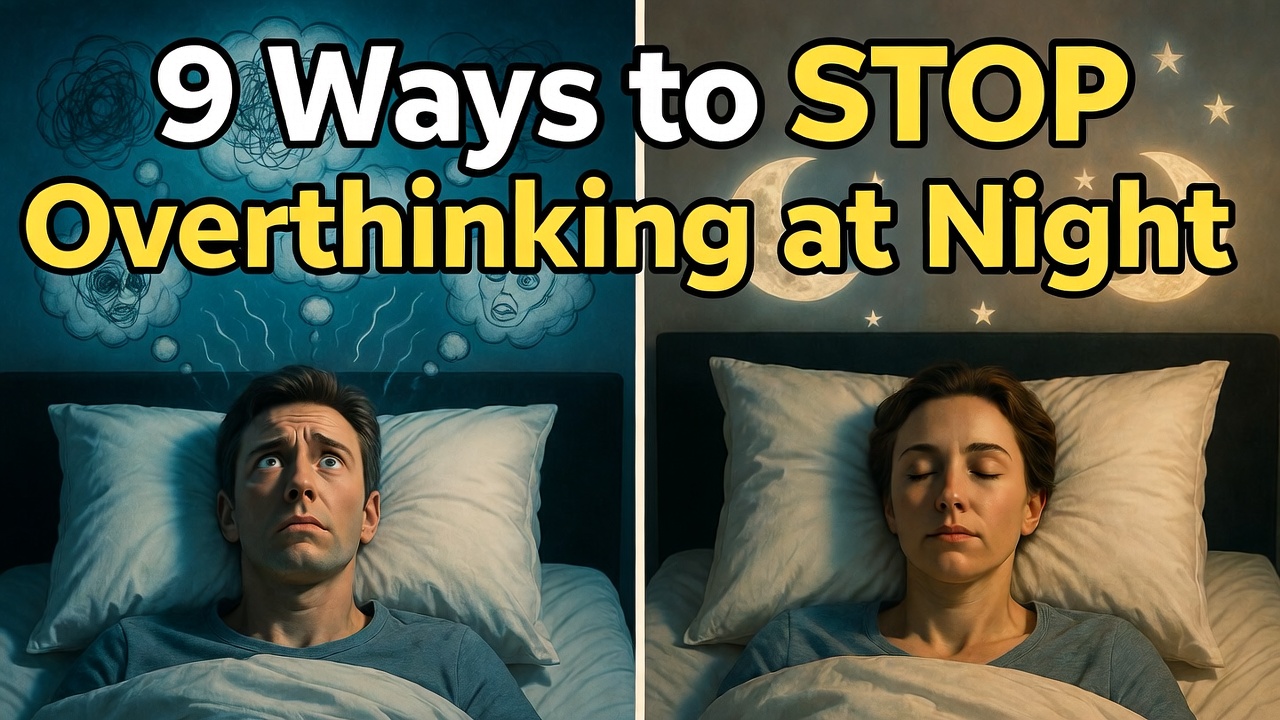
It’s 11:47 PM. You’re lying in bed, eyes closed, body exhausted. But your mind? It’s running a marathon.
You’re replaying that awkward thing you said three hours ago. Worrying about tomorrow’s meeting. Wondering if you locked the front door. Thinking about that text you should’ve sent differently. Analyzing every decision you made today. Your brain is like a browser with twenty tabs open, and none of them are closing anytime soon. No matter how tired you feel, you just can’t seem to stop overthinking at night.
Sound familiar?
You desperately want to stop overthinking at night, but the harder you try to quiet your mind, the louder those thoughts become. Maybe you’ve tried counting sheep. Maybe you’ve tried telling yourself to “just relax.” But here you are again, watching the minutes tick by, knowing tomorrow will be exhausting because tonight, sleep feels impossible.
If you’ve ever spent hours staring at the ceiling while your thoughts spiral out of control, you’re not alone. The struggle to stop overthinking at night affects millions of people, turning what should be peaceful rest into mental gymnastics. Your body is ready for sleep, but your mind has other plans running through endless scenarios, rehashing conversations, and creating problems that don’t even exist yet.
But here’s the good news: you can break this cycle. Learning how to stop overthinking at night isn’t about forcing your brain to shut down or fighting against your thoughts. It’s about understanding why this happens and having the right tools to gently guide your mind toward rest.
In this article, you’ll discover nine practical, science-backed techniques to stop overthinking at night and reclaim your sleep. No complicated routines. No expensive gadgets. No prescription medications. Just simple, effective strategies that actually work when your mind refuses to quiet down at bedtime.
What Is Overthinking at Night & Why Does It Happen?
Overthinking at night isn’t just “thinking a lot.” It’s that repetitive, often anxious pattern of thoughts that keeps your brain alert when it should be winding down. You might be rehashing past conversations, planning future scenarios, or worrying about things completely outside your control.
But why does this mental spiral happen specifically at night?
During the day, you’re busy. Your mind is occupied with tasks, conversations, and distractions. But when you finally lie down, the noise stops. And in that silence, your brain suddenly has space to process everything you’ve been pushing aside all day.
There’s also a biological component. When you’re stressed, your body produces cortisol a hormone that keeps you alert. If your stress levels are high throughout the day, that cortisol can linger into the evening, making it harder for your brain to shift into “rest mode.”
Add in the lack of visual stimulation and physical activity, and your mind has nothing to do except… think. And think. And overthink.

How Overthinking at Night Destroys Your Sleep & Mental Health
Let’s be honest: lying awake overthinking isn’t just frustrating—it’s genuinely harmful.
When you can’t stop overthinking at night, you’re not getting the deep, restorative rest your body needs. Racing thoughts before sleep prevent you from falling asleep, and poor sleep quality leads to:
- Next-day exhaustion that makes everything feel harder
- Increased anxiety and irritability because your nervous system never fully recovers
- Difficulty concentrating at work or in conversations
- A vicious cycle where worry about not sleeping makes the mental patterns even worse
Over time, chronic sleep deprivation from nighttime overthinking can contribute to more serious mental health challenges, weakened immunity, and decreased overall well-being.
The stakes are real. But so are the solutions.
9 Proven Techniques to Stop Overthinking at Night
1. Do a Complete Brain Dump Before Bed
Your mind keeps cycling through the same thoughts because it’s afraid you’ll forget something important. Give your brain permission to let go by writing everything down.
Why it works: When you transfer thoughts from your head to paper, you’re signaling to your brain that these concerns are “saved” and don’t need to be actively remembered. It’s like closing those browser tabs we talked about.
How to do it:
- Keep a notebook and pen on your nightstand
- 30 minutes before bed, spend 10 minutes writing whatever’s on your mind
- Don’t edit or organize—just dump it all out
- Include worries, to-do items, random thoughts, everything
- Close the notebook and leave it for tomorrow
The physical act of writing engages a different part of your brain and creates closure. You’re not avoiding the thoughts—you’re parking them somewhere safe. This simple practice helps you stop overthinking at night by giving those persistent worries a temporary home.
2. Practice the 4-7-8 Breathing Technique
When you’re caught in overthinking before sleep, your breathing often becomes shallow and rapid, which keeps your nervous system activated. Controlled breathing can reverse this.
Why it works: The 4-7-8 breathing pattern activates your parasympathetic nervous system your body’s natural “calm down” mechanism. It slows your heart rate and signals to your brain that it’s safe to relax.
How to do it:
- Breathe in through your nose for 4 counts
- Hold your breath for 7 counts
- Exhale completely through your mouth for 8 counts
- Repeat this cycle 4 times
Focus entirely on counting. This gives your mind a specific task instead of letting it wander into worry. Many people fall asleep before completing all four cycles because the technique naturally calms racing thoughts at night.
3. Try Cognitive Shuffling (The Random Word Game)
This sounds weird, but it’s incredibly effective for those who need to stop overthinking at night. Cognitive shuffling involves deliberately thinking random, unconnected thoughts to confuse your brain out of its anxious patterns.
Why it works: Overthinking follows logical patterns—one worry leads to another related worry. By introducing completely random, neutral thoughts, you interrupt that chain and prevent your brain from building momentum.
How to do it:
- Pick a random, neutral word (like “garden” or “window”)
- For each letter, think of other words starting with that letter and visualize them
- Example: Garden → G: giraffe (picture it), goat, grapes, guitar…
- Move to the next letter when you run out of ideas
- Keep visualizing each item briefly
Your thoughts become too scattered and boring for anxiety to maintain. Most people drift off within minutes because this method directly interrupts the patterns that keep you overthinking at night.

4. Establish a “Worry Window” Earlier in the Day
If you tend to worry about the same things every night, you need to give those thoughts attention at a different time. This technique helps you stop overthinking at night by addressing concerns before bedtime.
Why it works: Your brain overthinks at night partly because it hasn’t had dedicated time to process concerns. By scheduling worry time, you reduce the urgency your mind feels at bedtime.
How to do it:
- Choose a specific 15-minute window during the day (ideally early evening, not right before bed)
- Set a timer and let yourself think through your worries
- Write them down, problem-solve if possible, or simply acknowledge them
- When the timer ends, remind yourself: “I’ve given this attention. I can revisit it tomorrow during my worry window.”
At night, when thoughts creep in, gently redirect: “I’ll think about this during my scheduled time tomorrow.” This boundary helps you stop overthinking at night because your brain knows there’s a designated time for processing.
5. Create Physical Distance from Your Thoughts
Sometimes the best way to stop overthinking at night is to physically get out of bed.
Why it works: Your bed should be associated with sleep, not stress. If you lie there overthinking for too long, your brain starts linking your bed with anxiety rather than rest.
How to do it:
- If you’ve been lying awake for more than 20 minutes, get up
- Go to a different room with dim lighting
- Do something calming and boring: read something light, do gentle stretches, or sit quietly
- Avoid screens and bright lights
- Return to bed only when you feel genuinely sleepy
This technique, called “stimulus control,” helps retrain your brain to see your bed as a sleep zone, not a thinking zone. It’s particularly effective when you’re stuck in a loop and can’t stop overthinking at night.
6. Use the “5-4-3-2-1” Grounding Technique
When anxiety at bedtime has you spiraling, grounding exercises bring you back to the present moment and help you stop overthinking at night.
Why it works: Overthinking is usually about the past or future. Grounding anchors you to right now, where most of those worries don’t actually exist.
How to do it:
- Identify 5 things you can see (even in the dark: ceiling, curtain edge, etc.)
- Identify 4 things you can touch (pillow texture, sheet smoothness, mattress firmness)
- Identify 3 things you can hear (distant traffic, house settling, your breathing)
- Identify 2 things you can smell (your pillow, fresh air)
- Identify 1 thing you can taste (remnants of toothpaste)
Move slowly through each sense. This redirects mental energy away from racing thoughts and toward sensory awareness, making it much easier to calm your mind at night.
7. Build a Genuine Wind-Down Routine
Your brain needs transition time between “day mode” and “sleep mode.” Without it, overthinking fills the gap. A consistent routine is essential if you want to stop overthinking at night.
Why it works: Consistent pre-sleep routines signal to your brain that it’s time to power down. This biological cue becomes stronger the more consistently you practice it.
How to do it:
- Start your routine 60-90 minutes before bed
- Dim the lights throughout your home
- Do calming activities: light reading, gentle stretching, listening to quiet music
- Keep the routine similar each night so your brain recognizes the pattern
- Avoid anything stimulating: intense conversations, work emails, news, social media scrolling
Think of it like training a puppy. Your brain learns through repetition what comes next, which naturally helps you stop overthinking at night.
8. Challenge the Thoughts Rather Than Fighting Them
When you try to force yourself to “stop thinking,” you usually end up thinking more. Instead, question the thoughts gently to break the cycle of overthinking at night.
Why it works: Most nighttime worries are either exaggerated or about things you can’t control right now. By examining them calmly, you often realize they don’t need immediate attention.
How to do it:
When a thought appears, ask yourself:
- “Is this something I can actually do something about right now?”
- “What evidence do I have that this will actually happen?”
- “Will this matter in a week? A month?”
- “Am I catastrophizing?”
For example: “I’m worried I’ll mess up tomorrow’s presentation” becomes “I’ve prepared well. I can’t change anything at midnight. I’ll do my best, and that’s enough.”
You’re not dismissing valid concerns—you’re putting them in perspective. This cognitive approach helps you stop overthinking at night by addressing the root of anxiety rather than suppressing it.
9. Limit Mental Stimulation in the Hour Before Bed
This is the foundation all other techniques build on. If you’re feeding your brain stimulating content right before sleep, you’re making it nearly impossible to stop overthinking at night.
Why it works: Screens emit blue light that suppresses melatonin (your sleep hormone), and engaging content whether it’s news, social media drama, or work emails keeps your brain in active processing mode.
How to do it:
- Set a “digital sunset” one hour before bed no phones, laptops, or TV
- If you must use devices, use blue light filters and avoid anything emotionally charged
- Replace screen time with genuinely relaxing activities (not just “less stimulating” ones)
- Keep your phone outside the bedroom if possible, or at least across the room
This single change can dramatically reduce overthinking before sleep because you’re not constantly feeding your mind new information to process.
Common Mistakes That Make Nighttime Overthinking Worse
Even with good intentions, people often unknowingly sabotage their efforts to stop overthinking at night.
Trying too hard to fall asleep: The more you stress about not sleeping, the more alert you become. Sleep is something you allow, not force.
Using your bed for activities other than sleep: Watching TV, working, or scrolling in bed trains your brain that beds are for being awake and alert.
Checking the clock repeatedly: This creates anxiety about how little sleep you’re getting, which… makes it harder to sleep.
Negative self-talk: Telling yourself “I’m terrible at sleeping” or “I’ll never fix this” reinforces the problem. Your brain believes what you repeatedly tell it.
Irregular sleep schedules: Going to bed at wildly different times confuses your internal clock and makes it harder for your body to know when it’s sleep time.
Caffeine too late in the day: That afternoon coffee can still be affecting you eight hours later, keeping your nervous system more active when you’re trying to calm your mind at night.
What to Do If You Still Can’t Stop Overthinking at Night
If you’ve tried multiple techniques consistently for several weeks and you’re still lying awake with racing thoughts, it might be time to look at the bigger picture.
Address daytime stress: Sometimes the inability to stop overthinking at night is a symptom of chronic stress that needs attention during waking hours. Consider stress management practices like regular exercise, meditation, or talking with friends.
Examine your overall sleep hygiene: Is your bedroom too bright, too warm, or too noisy? Is your mattress uncomfortable? Sometimes environmental factors play a bigger role than we realize in our ability to stop overthinking at night.
Consider professional support: If anxiety at bedtime is severe or accompanied by other symptoms like panic attacks, persistent sadness, or intrusive thoughts, talking with a therapist can provide targeted strategies. There’s no shame in getting help it’s actually one of the smartest things you can do.
Be patient with yourself: Changing thought patterns takes time. Your brain has practiced overthinking for years. Give yourself grace as you build new habits to stop overthinking at night.

Final Thoughts: You Can Break Free from Nighttime Overthinking
Here’s what I want you to remember: you’re not broken. Your brain isn’t defective. The pattern that keeps you from being able to stop overthinking at night is your mind’s misguided attempt to protect you it just doesn’t realize that 2 AM isn’t the time for problem-solving.
You don’t need to implement all nine techniques at once. Start with one or two that resonate most. Maybe it’s the brain dump if you’re a list person, or the 4-7-8 breathing if you need something immediate. Build from there.
The goal isn’t to never have another thought at bedtime. It’s to change your relationship with those thoughts so they don’t have power over your sleep. Learning to stop overthinking at night is a skill, and like any skill, it improves with practice.
Small, consistent changes create real results. Tonight might not be perfect. Tomorrow might not be either. But a week from now, two weeks from now, you’ll notice something shifting. The thoughts will still come, but they won’t keep you awake quite as long. And eventually, you’ll find yourself drifting off peacefully, wondering what you used to worry about.
You deserve restful sleep. Your mind deserves peace. And with practice, you’ll stop overthinking at night and finally get the rest you’ve been craving.
Sweet dreams.
Explore More Articles to Empower Your Life
If you found value in learning how to Rewire Your Brain, you’ll love these related articles designed to help you grow and take control of your life:
- 9 Powerful Ways to Protect Your Mental Health at Work
- 7 Silent Signs of Emotional Burnout
- 7 Real Reasons You Feel Empty Inside (And How to Finally Fill That Void)
- 7 Proven Ways to Calm Your Mind Before Sleep and Fall Asleep Faster
If you’re interested in exploring deeper perspectives on the human mind, intelligence, spirituality, and moral growth, you may also find value in thoughtful articles published on Kham Khayal. The platform explores topics like human intelligence, the psychology behind forgiveness, spiritual awareness, and timeless moral values through a reflective and culturally rich lens. Reading diverse viewpoints helps broaden understanding and supports personal growth on multiple levels.